
A client of ours raised well over $100 million. The round was predicated on 12 successful beta deployments.
We were brought in for messaging, positioning, and demand generation. There were some big names already at the table advising them, we took that advice, and we skipped the step we normally insist on. We went straight to building.
Over the next six months we brought a lot of qualified companies to the table. Not one of them passed a proof of concept. Not one. That made me scratch my head.
I had a good relationship with the CRO who hired us, and eventually he let me into the data vault to look at the 12 betas the funding had been raised against.
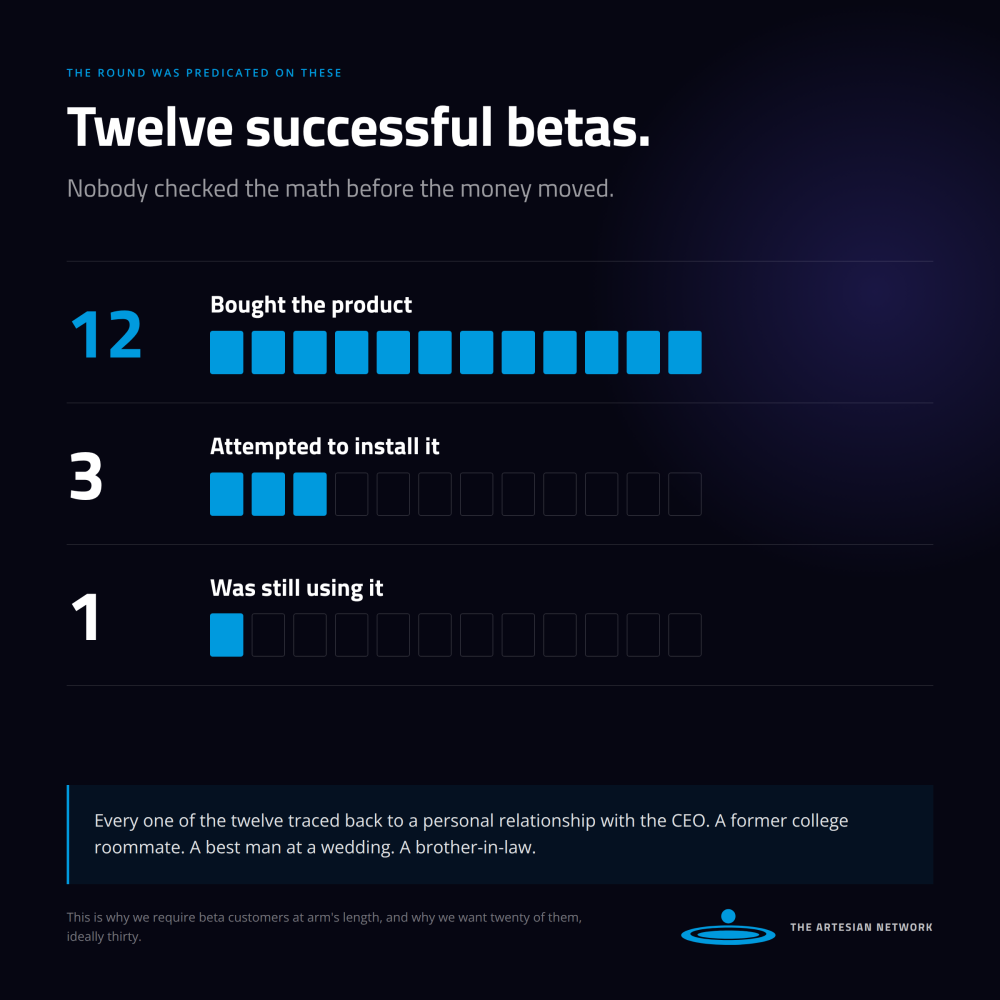
Every single one traced back to a personal relationship with the CEO. A former college roommate. A best man at a wedding. A brother-in-law.
All 12 had bought the product. Three had attempted to install it. One was still using it, and that one was the most recent purchase, so I have my doubts it lasted.
When we dug into why the POCs kept dying, we found it. The product depended on a piece of open-source code that was notorious for failing multiple times a week in any data center, and the architecture had been built around it. No engineer was going to put their career behind that.
We went back to the CEO and told him the problem was not the messaging. Buddha, Jesus, and Muhammad working in concert could not write copy that would move this product. It was a product problem, and it had to be fixed first.
He did not want to hear it, so we left. Three months later he fired the engineering team that made the design decision, and the co-founder who led it was gone with them. The company was eventually acquired in an asset sale.
Note what nobody did before that money moved: check the math behind the betas. Not the institutions writing the checks. Not the advisors. Not us.
The pattern that kills most of them
That story is an extreme version of something I see constantly. The product has not actually been proven, and the company starts spending as if it has.
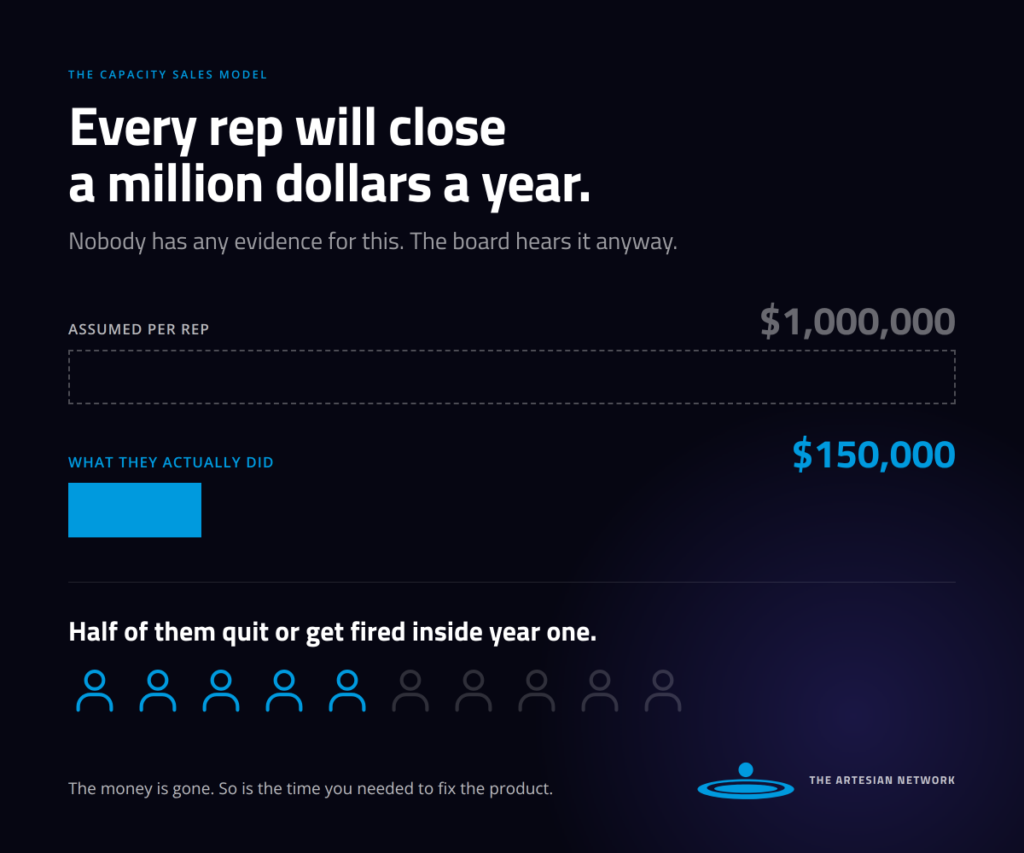
What usually follows is what I call the capacity sales model. A company has five or six betas, which is not a statistical sample of anything. They hire a VP of Marketing, or worse a CRO, far too early. That person builds a plan on assumptions that sound reasonable and have no evidence under them. Each rep will close a million dollars a year. Ramp takes three months. Turnover will be manageable.
None of it is proven. So they overhire in sales, overhire in marketing to feed sales, add sales engineers, and tell the board they are ready to go.
Then the reps do $150,000 each instead of a million, and half of them quit or get fired inside the first year.
So our job, before anything else, is to help a client protect the powder keg.
What we actually do
Nothing here is black magic. There is art in it, but most of it is science, and it runs in a deliberate order.
Start with the product, always. Before we spend a client’s money on going to market, we re-authenticate what they have. This is a delicate conversation. It cannot land as “I don’t believe you.” It has to land as “let’s prove this again before we spend your hard earned money.”
Betas have to be at arm’s length, and there have to be enough of them. Arm’s length means no prior relationship with the company or the founders. No in-laws, no former colleagues, nobody doing anybody a favor. And five is not a sample. I want to see 20, ideally 30, even in enterprise.
Look for statistical clustering, not enthusiasm. In that beta data we are hunting for a repeatable pattern: the same buyer persona, at companies that look alike, moving through the same customer journey. When that pattern shows up, several things get validated at once. The product fits an articulated need, you have the right persona, and you are saying the right things to get them to act. When it does not show up, you do not have product-market fit yet, no matter how good the logos look.
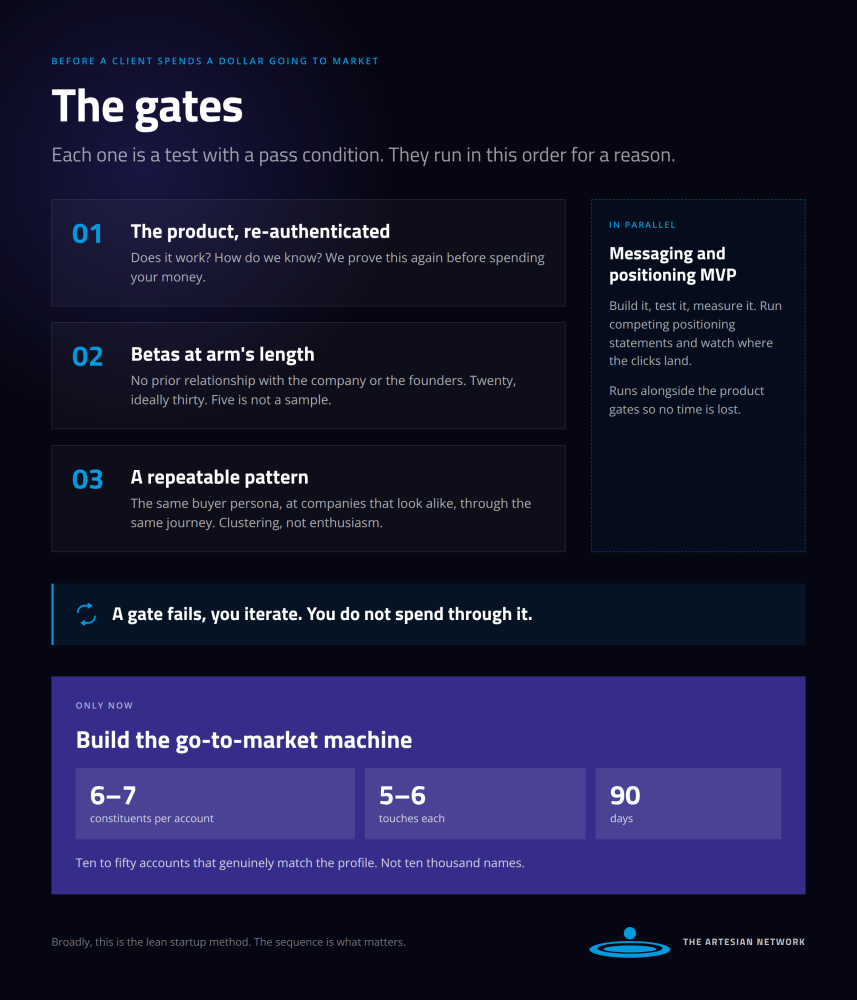
Run messaging and positioning in parallel, and test it like engineers. We do not treat positioning as a black art where people wave their hands and English majors have their way. We build an MVP for messaging and positioning, then we test and measure it. One cheap method: run Google Ads against competing positioning statements, not to sell anything, but to see where the clicks land. Our clients are mostly engineering-led, and by default they reach for a deeply technical message. Early visionaries will buy on that, which is exactly why beta enthusiasm gets confused with broader market reality. The rest of the market buys a business message. Much of what we do is translate from engineering to market.
Then, and only then, build the go-to-market machine. For enterprise, the formula we have proven repeatedly is six to seven constituents inside an account, reached five to six times, within 90 days. That math forces a choice most companies resist. We would rather have 10 to 50 accounts that genuinely match the ideal customer profile than 10,000 company names. Plenty of our clients arrive holding the 10,000. Spray and pray is cheaper to plan and far more expensive to run.
Broadly, this is the lean startup method. We were working this way before the book existed, and the sequence matters more than the label. Each step is a gate. If a gate fails, you iterate until it passes rather than spending through it.
In practice that is harder than it sounds, because a CEO who just closed a round has new investors who are anxious to see the money moving.
Now, about selection bias
Here is the fair challenge, and I got it directly in a conversation this week with Sydney Liu, who is writing about why some companies beat the odds: are your results just a function of picking good companies?
Let me be precise rather than defensive.
We do not get to look at the books. We are not investors, we have no diligence access, and we are not in a position to screen for financial quality even if we wanted to.
We do turn down clients. But almost never on the product or the composition of the company. It comes down to the CEO, and specifically to whether the engagement is workable. Many first-time CEOs with engineering backgrounds think of marketing as a set of task takers waiting on the CEO’s instructions. There is a well-known animosity there, and when a CEO is inflexible about it, the process cannot run. That is a real filter and I will own it.
So yes, there is a selection effect, and it is on coachability, not on quality. I would argue that distinction is the whole point. We are not finding companies that were going to win anyway. We are declining to work with founders who will not let the gates be gates.
For the ones who will, here is what I can tell you. Only about 5% even make it to a Series C before fizzling out. We work exclusively with early-stage companies, and since founding the firm in 2009 we have taken on about 60 of them.
Not every one of those was ever eligible for an exit, and I think the honest number has to account for that. One client was already public when we started working with them. Another was The Linux Foundation, which is not an organization that was ever going to get acquired. Counting only the clients that were actually eligible, roughly 60% have gone public, some reaching unicorn status, or been acquired in a successful exit.
Pure asset sales do not count. The company I opened this piece with was eventually acquired, and it is not in that 60%.
I do not say that from arrogance. I say it because I think the process is doing the work, and because the alternative explanation does not hold up. We never saw the books.
A typical engagement runs $15,000 to $30,000 a month for a full team that executes, not just an advisor. The in-house equivalent, a fully loaded CMO plus the directors and staff underneath, runs well over $1 million a year all in. We built a calculator on our site that walks through the real number, and it tends to surprise founders who have only been thinking about base salaries. That million(+) dollar team also carries a strong likelihood of turning over inside 12 to 18 months, because the fit was never right to begin with. Marketing is the worst function in the company for that.
The payroll math is the obvious part. What matters more is that every program dollar is now pointed at something proven.
If you want the longer version of the methodology, I laid it out in an article called Build It, Test It, Prove It. It has picked up more than 58,000 views, so it apparently struck a nerve with people living this problem.
Jonathan W. Buckley
Founder & CEO, The Artesian Network