At Artesian, we’ve been quietly dedicating resources to something we believe will become a core strategic advantage for our clients.
We are developing custom GPTs designed to perform deep, empirical strategic work—not generic automation.
Enterprise PMF Advisor is the first of these.
It is engineered using: • Our experiential data from years of B2B technology launches • Internal frameworks we’ve proven repeatedly in-market • The most current industry benchmarks and best practices in B2B PMF, GTM, and scaling readiness
The goal is not to replace people.
The goal is to drive: precision, objectivity, and quality—at speed.
In this episode of ‘Scale Like a CEO,’ we dive deep into the world of scaling B2B tech companies. Our guest, Jonathan Buckley, founder of Artesian Network, discusses the importance of having multi-disciplined generalists in early-stage startups, the critical role of product-market fit, and the challenges of leadership in tech. Jonathan also shares insights on why hiring a permanent CMO too soon can be detrimental and how fractional roles, including CFOs, can drive early-stage success. Tune in for expert strategies and innovative approaches that are reshaping the way startups grow and scale.
Trained as an economist, Jonathan W. Buckley began his career in the federal government before moving into telecom and later Arthur Andersen’s consulting practice, where he advised major technology players including Sun Microsystems. By the late 1990s, Buckley joined the founding team of NetBrowser Communications.
“I was the chief operating officer, responsible for everything from sales to accounting. But it was through the coaching of our chairman of the board that I was pushed toward marketing and business development,” Buckley says. It was an experience that shaped the rest of his career, leading him to serve as CMO for both public and private tech companies in Silicon Valley before founding The Artesian Network, a team of marketing professionals focused exclusively on scaling early stage B2B technology companies. With more than three decades of experience across consulting, operations, and marketing, Buckley has built a reputation as an advisor who sees business growth as a system rather than a set of disconnected tactics.
Jonathan recently sat down with techbullion.com and provided his insights on building credibility as a trusted advisor. Read the article here.
Early in my career, in the role of Business Development, I once walked into a boardroom convinced I had the perfect pitch. 30 slides. Financial models. Competitive benchmarks. Every detail nailed down.
I thought the math would speak for itself. It seemed compelling enough for me and the team backing me.
It didn’t.
Halfway through, the CFO was scrolling his laptop, the COO doodled in her margins, and the CEO looked politely detached. The deal never closed. It was over.
Months later, I tried again. This time I led with a story. A real company in their industry, with the same problem they faced, the same anxieties, and the same tough decision. I walked them through what happened when that company chose change. I created context, drama, tales of true outcomes.
The math didn’t disappear. It just came later—after the room leaned in and in support of the story, not the lead. That deal closed in 45 days.
Hundreds of millions of dollars in Sales, Corp Dev, Business Development and money-raising transactions later, I can summarize the tips to closing large deals in four basic steps. No, this is not comprehensive sales training. I have been schooled over the years in three major enterprise sales frameworks. Sandler, SPIN Selling, and Challenger Sale in addition to specialized Business Development training created by Arthur Andersen when I was a business consultant there. This outline in no way can replace the breadth and depth of these frameworks.
What I am attempting here is to take an abstraction of all of them and then shaping the macro concepts into a simple outline with the backdrop of having either leading large transaction deals or supporting them as the Marketing Executive/Team.
The Science of Why Story Wins
Stories are not fluff. They’re science. There is some real math to show why you absolutely need to start with a story, not “a pitch”, but a narrative. Why?
People remember facts “22 times more effectively” when told in story form (Stanford study).
A well-told story activates up to “seven regions of the brain”, compared to two for raw data (Princeton study).
“95% of purchase decisions are subconscious” and rooted in emotion (Harvard study).
For high-value deals, where risk looms large, story changes the math. Consider the Expected Value equation buyers run in their heads:
“EV = (Probability of Success × Benefit) – (Probability of Failure × Loss)”
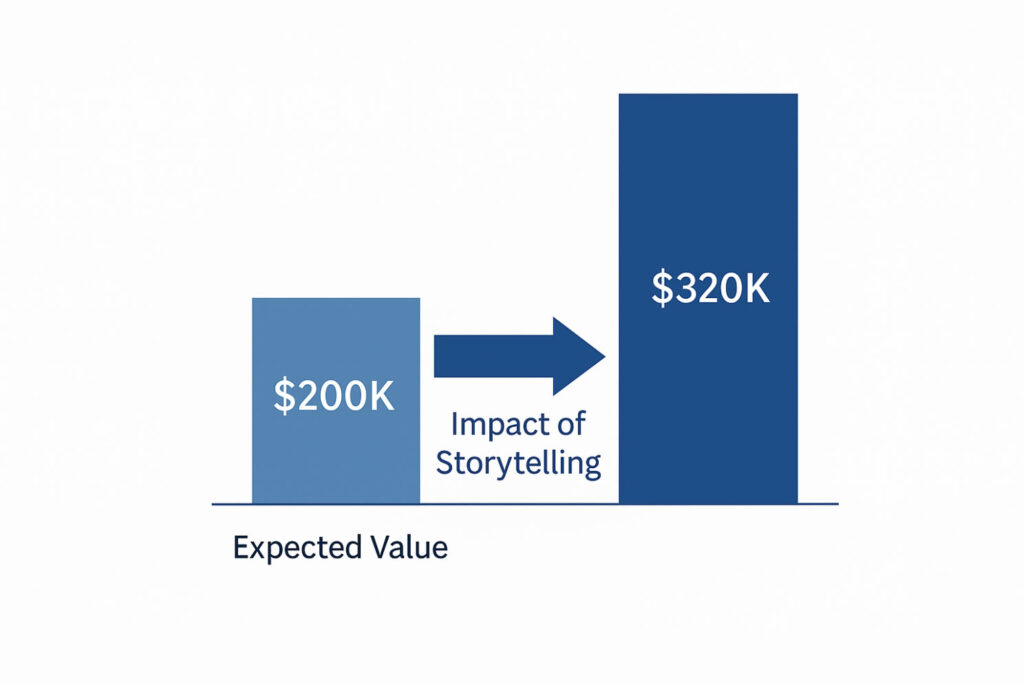
Without story, they may peg success at 50%. With a compelling narrative—supported by a case study, testimonial, or analogy—they might raise it to 70%.
– No story: (0.5 × $500K) – (0.5 × $100K) = $200K EV – With story: (0.7 × $500K) – (0.3 × $100K) = $320K EV
That’s a “60% increase in perceived value”—from the same numbers, framed differently. This is why you need to be teamed up with a very strong storyteller in your marketing department who is skilled in the precision of messaging and positioning.
The Hidden Science of Enterprise Pre-Selling
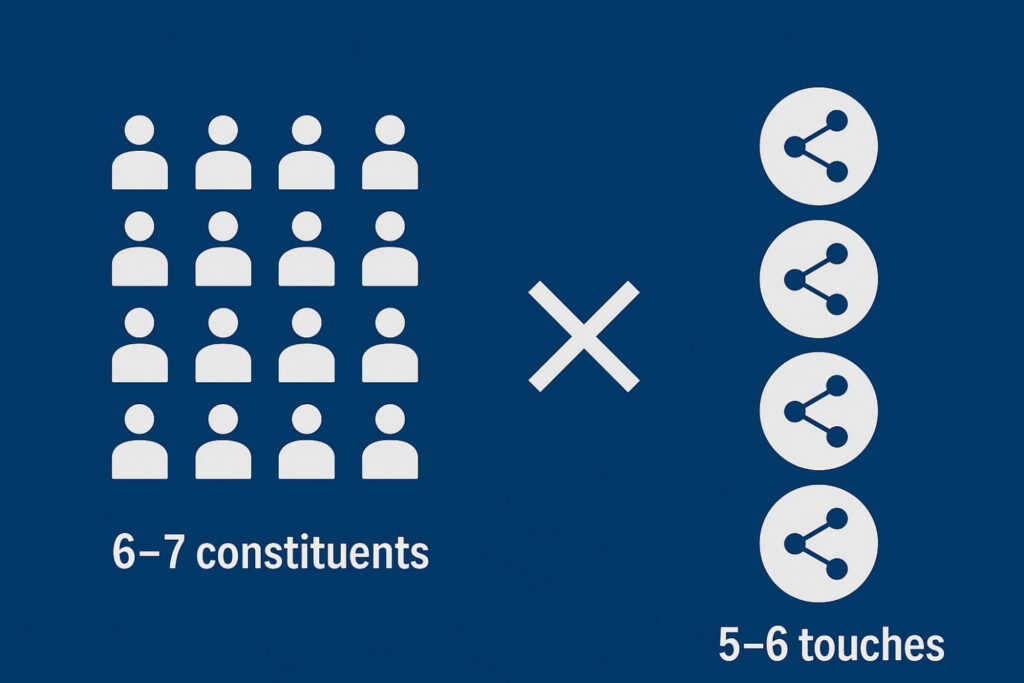
By the time you’re in the room, the battle is half-won or half-lost. Enterprise deals don’t generally come down to one decision-maker. On average, there are 6–7 constituents involved in a large Enterprise sale: champions, skeptics, influencers, and decision-makers. Studies show this, my experienced validated this.
Marketing science tells us that each needs to be touched 5–6 times before they’re even open to a serious sales conversation.That means the real work begins before the pitch—with marketing that tells stories, primes trust and creates familiarity across the buying committee. Without this groundwork, the perfect story in the room may never get its chance.
This math of hitting 6-7 constituents 5-6 times should be the obsession of your marketing department or marketing partner. Each constituent will have different fears, uncertaintiesnbsp;andnbsp;doubts and they much be addressed uniquely in accordance with role in the company. Your marketing partner should be tailoring this messaging.
A simple example of such tailoring would be to examine the difference in content to say, a Vice President or C level exec versus, say, a director level professional. VP+ tend to be more concerned about issues of strategy, competitiveness and 18 month+ outlooks. Director level professionals tend to be more concerned with budgets and staffing impacts of large buying decisions. Staff and manager levels tend to be more concerns with more of a personal risk assessment. How does this impact them day-to-day. We do a lot of this work. It is effective.
The Four Phases of Closing Large Deals
Every big deal I’ve seen close follows the same rhythm.
First comes Preparation. You do the research—industry trends, financials, competitors. You map the stakeholders: who decides, who influences, who blocks. You build a narrative that connects your solution to their pain points, not in abstract, but in terms they live every day.
Then comes the Pitch. This isn’t about features; it’s about outcomes. You tell the story of how someone like them achieved results. You show the financial impact, yes—but you anchor it in a human journey they can see themselves in.
Next is Trust. You don’t win this with polish. You win it by being real—transparent about risks, clear about limitations, generous with references. You stop being a vendor and start being a partner.
Finally, Closing. Big deals don’t close on discounts; they close on clarity. You simplify decision paths, tie your solution to urgent priorities, and make the cost of inaction greater than the cost of investment. And you leave the room with shared ownership of what success looks like.
Bringing It All Together
Here’s the truth: spreadsheets don’t close seven-figure deals. Stories do. But stories alone aren’t enough. You need the right story, told to the right people, at the right time, within a disciplined process.
Marketing lays the groundwork.
Storytelling shapes the pitch.
Execution seals the deal.
Data convinces. Story converts.
And when the stakes are highest, story isn’t just a nice-to-have—it’s the difference between a lost opportunity and a transformative win.
💡 Takeaway: If you’re chasing large enterprise deals, stop polishing the deck and start crafting the narrative. Because when the story is right, the math finally makes sense.
AI is no longer a novelty in B2B tech marketing—it’s a competitive necessity. But while many marketers are exploring how generative AI can save time, fewer are using it to actually improve the quality of their positioning and messaging. At The Artesian Network, we’ve been launching and scaling AI-driven companies since 2017, well before ChatGPT introduced the broader market to what was possible. What we’ve found is that the power of AI in marketing isn’t about replacing expertise—it’s about multiplying it. When used well, AI helps experienced marketers move faster, test more ideas, and spot value gaps that human teams often miss. Here are ten best practices we use to get the most out of AI for B2B messaging and positioning:
1. Start with a Value-Claims Analysis Table
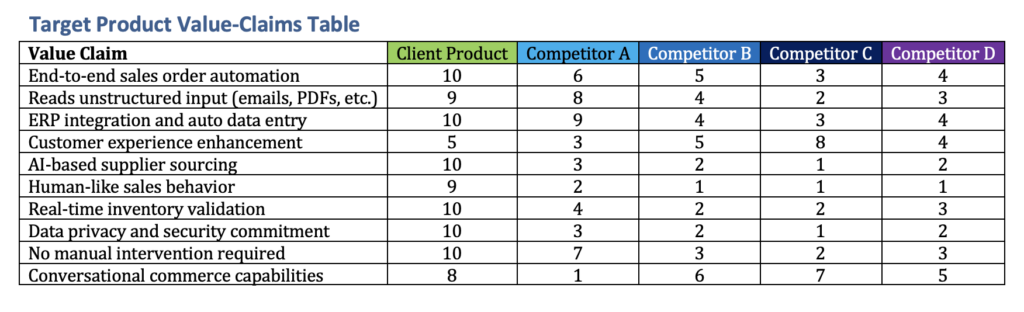
Before you write a single line of copy, use AI to map your product’s value claims against those of key competitors or substitutes. At The Artesian Network, we start this process by instructing the AI to summarize the marketing claims from competing product pages into a condensed list of recurring value statements—phrases like “faster onboarding,” “low-code customization,” or “seamless integrations.” To do this effectively, we: – Feed the AI the exact URLs of competitor websites—especially their product, solutions, and use case pages. – Instruct it to extract and normalize claims into consistent language. – Ask it to count how many times each claim appears on each competitor’s site to gauge emphasis and repetition. This process produces a value-claims matrix showing which claims are ubiquitous (table stakes), overused (hard to differentiate), and which are clear gaps your product can credibly own. But here’s the key: We always consolidate down to just 4–5 focused value claims for your product. These should be the claims your messaging consistently reinforces—across site copy, decks, demos, and outbound. Why? Because spread too thin, your positioning becomes noise. Concentrated, it becomes power. And it goes without saying: you must actually deliver on the claims you make. The most dangerous positioning mistake is to promise what the product doesn’t support—because that’s not positioning, that’s just brand erosion in disguise.
Value-Claims Analysis Output
2. Prime AI with a Fully-Formed Contextual Folder
Think of your AI as a junior strategist—it only performs well when it’s given a complete context pack: – ICP and buyer persona breakdowns – Buyer committee roles (typically 6–7 stakeholders in enterprise sales) – Competitive collateral and positioning – Industry-specific language and macro/microeconomic conditions – Pricing dynamics (commodity, premium, or disruptive) – Funding paths (which budget line the purchase comes from) Without this structure, outputs will always lack depth.
3. Clarify the Type of Sale
AI needs to know if you’re competing on price, features, ecosystem, or disruption. For instance: – A commodity sale competes on cost and utility. – A disruptive sale might draw funds from innovation or transformation budgets. That distinction radically changes how you frame benefits, urgency, and objections.
4. Define the Desired Messaging Tone and Voice Upfront
The best results come when you establish whether the voice should be authoritative, optimistic, provocative, or humble. AI excels at adaptation—but only when you’ve specified your brand’s persona clearly.
5. Use AI to Generate Hypotheses—Then Pressure-Test Them with Sales
Let AI rapidly propose alternative ways of expressing your value prop. Then run those through your sales team or revenue leaders. Often, the best ideas don’t come from a boardroom—they come from a rep’s inbox.
6. Train AI to Recognize Vertical-Specific Language and Pain Points
Generic messaging kills enterprise momentum. Load the AI with case studies, call transcripts, and customer quotes specific to your vertical. This primes it to speak the buyer’s language—without sounding robotic or detached.
7. Generate Variant Messaging for Each Buyer Committee Role
Your economic buyer, technical evaluator, and frontline user all care about different things. Use AI to tailor benefits for each: – CTOs care about scalability and integrations. – Operations leaders want faster workflows. – CFOs focus on ROI, not features. AI can handle that personalization at scale—if you feed it role-specific prompts.
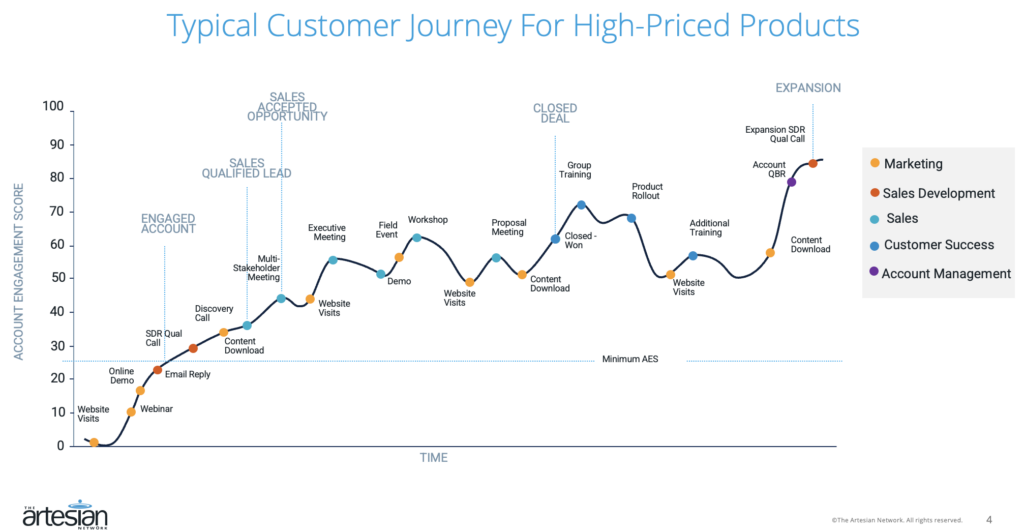
8. Map Messaging to the Buying Journey
AI can accelerate the creation of nurture sequences, but only if you map messaging to awareness, consideration, and decision stages. Use AI to test which content themes move leads downstream fastest.
A Typical Enterprise Customer Journey Map
9. Avoid Over-Reliance on Prompt Templates—Invest in Prompt Craft
The best outcomes don’t come from prompt libraries—they come from experienced prompt engineers who understand marketing strategy. AI is only as strong as the marketer guiding it. You wouldn’t give a Ferrari to a student driver. Same rules apply here.
10. Continuously Refresh Competitive Inputs and Market Signals
Your AI models and prompt structures should evolve with your market. Refresh inputs monthly or quarterly: – New product launches – Pricing shifts – Analyst reports – Buyer objections from sales calls This ensures your messaging doesn’t go stale—and your positioning stays ahead.
Final Thought
AI doesn’t replace your positioning strategy. It reveals the gaps, accelerates the iterations, and makes it easier to go to market with confidence. But only if it’s used by people who know what they’re doing. At The Artesian Network, we build that process into every GTM engagement. Because the future of B2B marketing belongs to those who can see the signal in the noise—and move fast on it.