Are you a tech founder in the early phases of scaling your business and proving your revenue model? Over 50% of our clients have ultimately reached a successful exit, while many others have progressed to advanced stages of financing to support their growth.
In a recent interview, I discussed our process and key learnings at a high level.
For starters, it’s crucial to refine your messaging and positioning alongside identifying your targets and building the systems necessary for automating demand generation. We see this process skipped all the time, unfortunately. This approach simplifies the task of developing leads significantly.
At The Artesian Network, we integrate with your existing team by providing a full fractional marketing team to help you scale effectively. This strategy preserves capital, increases speed, and utilizes the latest advancements in marketing.
As we often say, “Find Your Repeatable Revenue Model, FASTER.”
If you’re interested in having your business reviewed or sharing best practices and experiences, feel free to book a free 30-minute consultation with me.
Currently browsing: Uncategorized
The hardest part of starting up is starting out.
Scaling Startups to Exit with Jonathan Buckley, Founder The Artesian Network

The Art (and Science) of Storytelling in Enterprise Sales
Early in my career, in the role of Business Development, I once walked into a boardroom convinced I had the perfect pitch. 30 slides. Financial models. Competitive benchmarks. Every detail nailed down.
I thought the math would speak for itself. It seemed compelling enough for me and the team backing me.
It didn’t.
Halfway through, the CFO was scrolling his laptop, the COO doodled in her margins, and the CEO looked politely detached. The deal never closed. It was over.
Months later, I tried again. This time I led with a story. A real company in their industry, with the same problem they faced, the same anxieties, and the same tough decision. I walked them through what happened when that company chose change. I created context, drama, tales of true outcomes.
The math didn’t disappear. It just came later—after the room leaned in and in support of the story, not the lead. That deal closed in 45 days.
Hundreds of millions of dollars in Sales, Corp Dev, Business Development and money-raising transactions later, I can summarize the tips to closing large deals in four basic steps. No, this is not comprehensive sales training. I have been schooled over the years in three major enterprise sales frameworks. Sandler, SPIN Selling, and Challenger Sale in addition to specialized Business Development training created by Arthur Andersen when I was a business consultant there. This outline in no way can replace the breadth and depth of these frameworks.
What I am attempting here is to take an abstraction of all of them and then shaping the macro concepts into a simple outline with the backdrop of having either leading large transaction deals or supporting them as the Marketing Executive/Team.
The Science of Why Story Wins
Stories are not fluff. They’re science. There is some real math to show why you absolutely need to start with a story, not “a pitch”, but a narrative. Why?
People remember facts “22 times more effectively” when told in story form (Stanford study).
A well-told story activates up to “seven regions of the brain”, compared to two for raw data (Princeton study).
“95% of purchase decisions are subconscious” and rooted in emotion (Harvard study).
For high-value deals, where risk looms large, story changes the math. Consider the Expected Value equation buyers run in their heads:
“EV = (Probability of Success × Benefit) – (Probability of Failure × Loss)”
Without story, they may peg success at 50%. With a compelling narrative—supported by a case study, testimonial, or analogy—they might raise it to 70%.
– No story: (0.5 × $500K) – (0.5 × $100K) = $200K EV – With story: (0.7 × $500K) – (0.3 × $100K) = $320K EV
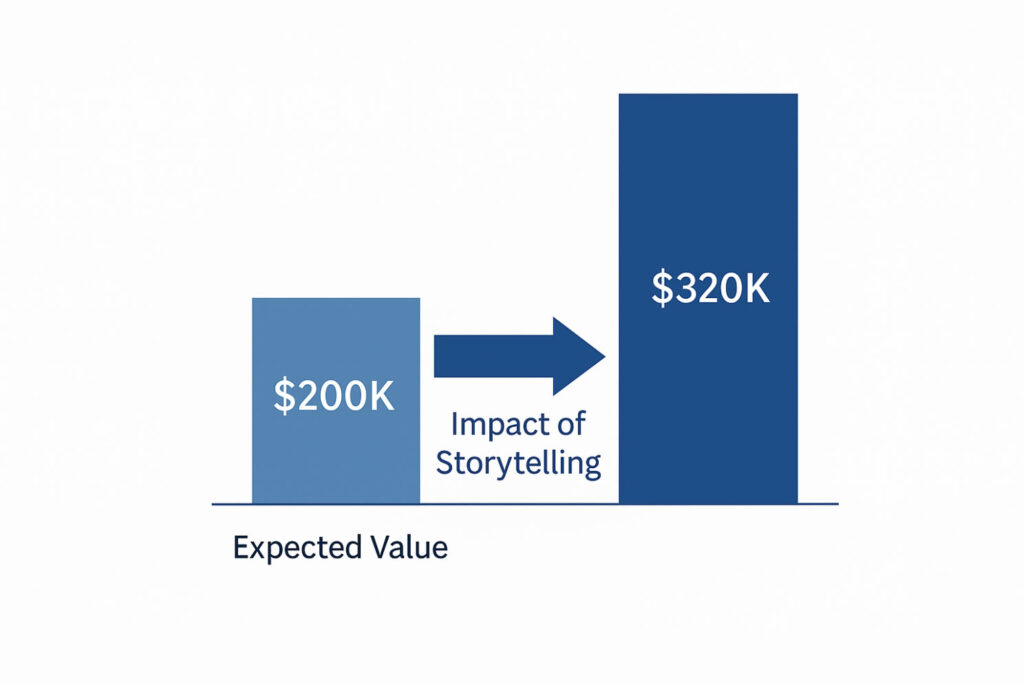
That’s a “60% increase in perceived value”—from the same numbers, framed differently. This is why you need to be teamed up with a very strong storyteller in your marketing department who is skilled in the precision of messaging and positioning.
The Hidden Science of Enterprise Pre-Selling
By the time you’re in the room, the battle is half-won or half-lost. Enterprise deals don’t generally come down to one decision-maker. On average, there are 6–7 constituents involved in a large Enterprise sale: champions, skeptics, influencers, and decision-makers. Studies show this, my experienced validated this.
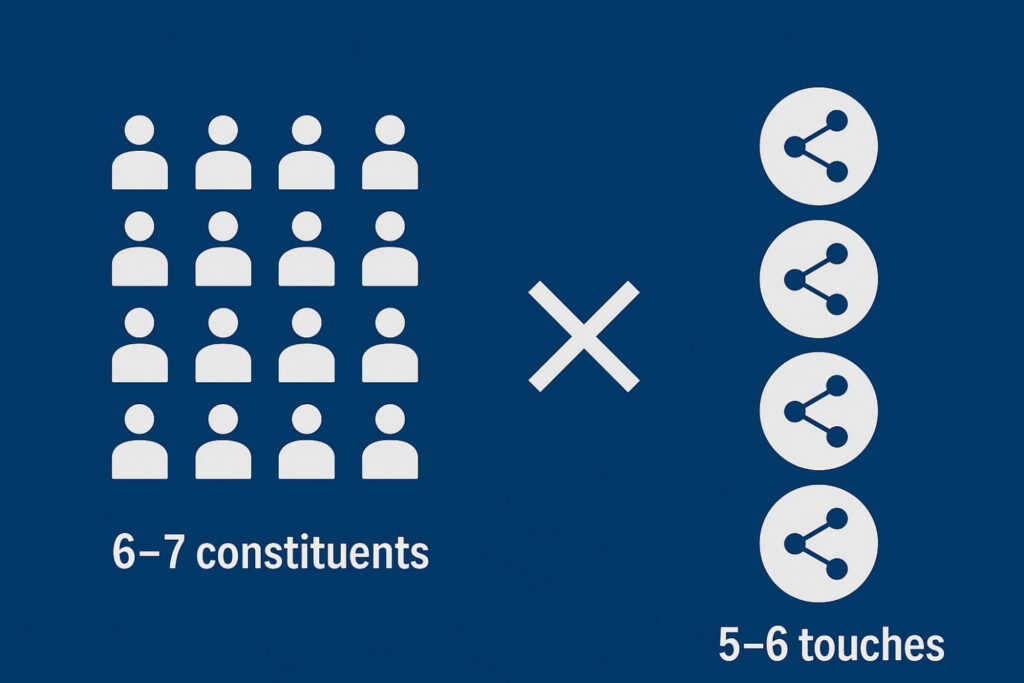
Marketing science tells us that each needs to be touched 5–6 times before they’re even open to a serious sales conversation.That means the real work begins before the pitch—with marketing that tells stories, primes trust and creates familiarity across the buying committee. Without this groundwork, the perfect story in the room may never get its chance.
This math of hitting 6-7 constituents 5-6 times should be the obsession of your marketing department or marketing partner. Each constituent will have different fears, uncertaintiesnbsp;andnbsp;doubts and they much be addressed uniquely in accordance with role in the company. Your marketing partner should be tailoring this messaging.
A simple example of such tailoring would be to examine the difference in content to say, a Vice President or C level exec versus, say, a director level professional. VP+ tend to be more concerned about issues of strategy, competitiveness and 18 month+ outlooks. Director level professionals tend to be more concerned with budgets and staffing impacts of large buying decisions. Staff and manager levels tend to be more concerns with more of a personal risk assessment. How does this impact them day-to-day. We do a lot of this work. It is effective.
The Four Phases of Closing Large Deals
Every big deal I’ve seen close follows the same rhythm.
First comes Preparation. You do the research—industry trends, financials, competitors. You map the stakeholders: who decides, who influences, who blocks. You build a narrative that connects your solution to their pain points, not in abstract, but in terms they live every day.
Then comes the Pitch. This isn’t about features; it’s about outcomes. You tell the story of how someone like them achieved results. You show the financial impact, yes—but you anchor it in a human journey they can see themselves in.
Next is Trust. You don’t win this with polish. You win it by being real—transparent about risks, clear about limitations, generous with references. You stop being a vendor and start being a partner.
Finally, Closing. Big deals don’t close on discounts; they close on clarity. You simplify decision paths, tie your solution to urgent priorities, and make the cost of inaction greater than the cost of investment. And you leave the room with shared ownership of what success looks like.
Bringing It All Together
Here’s the truth: spreadsheets don’t close seven-figure deals. Stories do. But stories alone aren’t enough. You need the right story, told to the right people, at the right time, within a disciplined process.
Marketing lays the groundwork.
Storytelling shapes the pitch.
Execution seals the deal.
Data convinces. Story converts.
And when the stakes are highest, story isn’t just a nice-to-have—it’s the difference between a lost opportunity and a transformative win.
💡 Takeaway: If you’re chasing large enterprise deals, stop polishing the deck and start crafting the narrative. Because when the story is right, the math finally makes sense.
IPO success in B2B tech isn’t about luck or flashy features.
After 25 years across 3 continents, I’ve learned it comes down to core fundamentals most founders overlook.
Get those right, and you’re not guessing, you’re building.
Read more: https://lnkd.in/eM9c9dRr
2025 B2B Marketing ROI Rankings for Early-Stage Tech Startups
Each year around mid-year, we at The Artesian Network recheck the numbers from the latest B2B benchmark data and provide and outlook for ROI across the top 15 marketing tactics.
CMOs and CEOs in early-stage tech—where should you really put your limited marketing budget? When every dollar needs to work twice as hard, it’s essential to know which channels actually drive ROI. I’ve ranked the top 15 B2B marketing activities—from highest to lowest return—based on the latest 2025 benchmark data.
The Shortlist You Actually Need
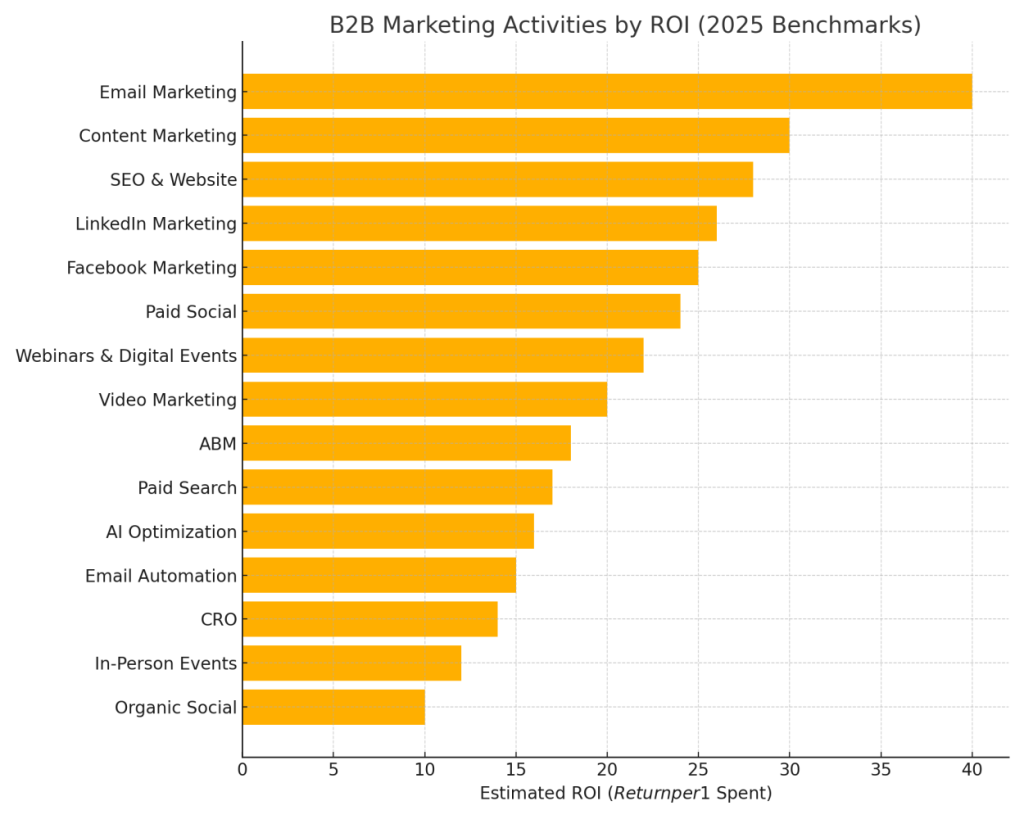
- Email Marketing – $36–42 per $1. Don’t overthink this. Own your audience.
- Content Marketing – Your long-game lead machine. Fuels SEO, sales enablement, and trust.
- Organic SEO + Website – Still the best compounding asset.
- LinkedIn Marketing – Most efficient social spend for B2B. Both ads + thought leadership.
- Facebook Paid + Organic – Counterintuitive, but ad ROI holds strong.
- Paid Social (FB, TikTok, IG) – Effective when hyper-targeted.
- Webinars & Digital Events – Excellent for deep-funnel conversion.
- Video Marketing – Explainer videos > pitch decks.
- ABM – High value if your ACVs justify the effort.
- Google Search Ads – High-intent search = quick wins.
- AI Optimization – 90% of marketers see ROI lift using AI for campaign tuning.
- Email Automation – Lifecycle emails close deals.
- CRO – Boost every other channel’s efficiency.
- In-Person Events – Strategic, not scalable (yet).
- Organic Social (X, Reddit, etc.) – Brand building, not pipeline drivers.
For Founders & CMOs: What to Prioritize
- Nail email, SEO, and content early—they scale affordably and compound.
- Use LinkedIn + paid social to get short-term momentum and test messaging.
- Reserve ABM, AI, and CRO for when you’ve got traction and data to optimize.
If your CAC is creeping up or your pipeline isn’t moving, your channel mix may be the culprit.
👉 CMOs, what’s working for you right now?
👉 Founders, where are you planning to place your next bet?
Let’s compare notes 👇 in the comments section, and feel free to get in touch with us at www.artesiannetwork.com
More about me here: https://www.jonathanwbuckley.com